Architecture of Grief is an immersive architectural framework that restores visibility to mourning. Drawing from Victorian domestic rituals, celestial mapping, textile traditions and photography, the project constructs spaces where grief is witnessed rather than hidden.
Each elemental functions as both object and threshold—a rug that records touch, a ceiling that holds the night sky, a writing table for communal testimony, a wall that bears the weight of memory.
The work asks: What if grief had architecture?
What if mourning was not private, but spatial?
Threshold — The Parlor
Antique lace panels suspended in arc form.
Domestic labor becomes memorial surface.
What was once intimate becomes collective.
Writing Table and Witness Wall and Textile — The Parlor
A long communal table lit by candlelight.
Visitors write..
Language settles into the room as presence.
Walls become the only witness.
Solidly grounded.
Witness Wall and view from the Writing Table - The Parlor
Submerged Veil Rug — The Parlor
The Cosmic Room
A suspended night sky calibrated to shifting constellations.
Two skies exist at once-above and below collapse.
The body lies between them.
The Cosmic Room
Moonlit Rug
Cosmology of Love -Poem
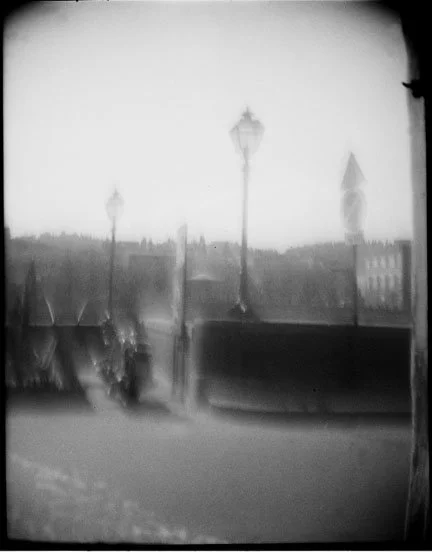
The Pier (Witness/Approach)
Two images: one in motion, one still.
Grief is the distance between passing and standing.
The Pier
Golden Hour Rug
A circular wool field calibrated to shifting light.
Touch alters the surface.
Return reveals change..
Golden Hour Rug
Golden Hour Rug - Textured in warm and cool lighting
The Considering Room
The work explores the architecture of deliberation — the quiet space between impulse and action — where presence itself becomes the central act.
The Considering Room
1/4 Mourning
A 12 x 12 grid of illuminated blue glass insulators forms a charged field with one node missing at the center. The work considers how life continues while something essential remains structurally missing.
1/4 Mourning
1/4 Mourning - Detail
The Veil
In many cultures, white marks transition. The Veil expands this tradition through large-scale collage and architectural installation, positioning white as veil, threshold, and reflective surface — a space where grief becomes visible without spectacle.
Smaller galleries invite an intimate screen. In larger spaces, it becomes a permeable room inviting movement within and around the veil.
The Veil
Fragment(s)
Lace doilies are cast in encaustic and mounted as individual relics.
Many are donated in memory of someone lost.
Together they form a dispersed field across the wall—mourning as accumulation rather than event.
Fragment
Fragments
She Drinks the Moon
Three figures stand as quiet guardians of grief.
Each holds a different sky— current, memory, and what remains unseen.
The body becomes vessel.
Emotion moves through it like tide.
She Drinks the Moon